The Colossus of Rhodes
- Anya C.
- Jun 15, 2025
- 3 min read
Imagine sailing a boat filled with goods to trade at Rhodes. The second you enter, you instantly spot the massive bronze statue of the Greek sun god, Helios. That was the Colossus of Rhodes, one of the Ancient Wonders of the World built in 280 BC, after a legendary victory against another invading army from the people of Rhodes. However, this renowned monument only lasted a little while before collapsing in an earthquake 54 years later. Nonetheless, it was a remarkable feat of engineering that still impacts our world today.
The Colossus of Rhodes was located on the island of Rhodes in ancient Greece, which, at the time, was one of the most powerful and influential islands in that geographical area. It could easily be seen by arriving ships, as an indicator of where the port is located as well as a tribute to the sun god. It was estimated to stand at a staggering height of 33 meters, which is roughly two-thirds the size of the Statue of Liberty. The statue was built to celebrate their victory against the Macedonian attack on their island led by their ruler, Demetrius in around 293-292 BC. The construction began in 292 BC and took around 12 years to complete, therefore being completed in 280 BC. The main engineer and architect behind the Colossus of Rhodes was Chares of Lindos, along with a multitude of artisans, labourers, and other engineers, who helped construct this engineering marvel.
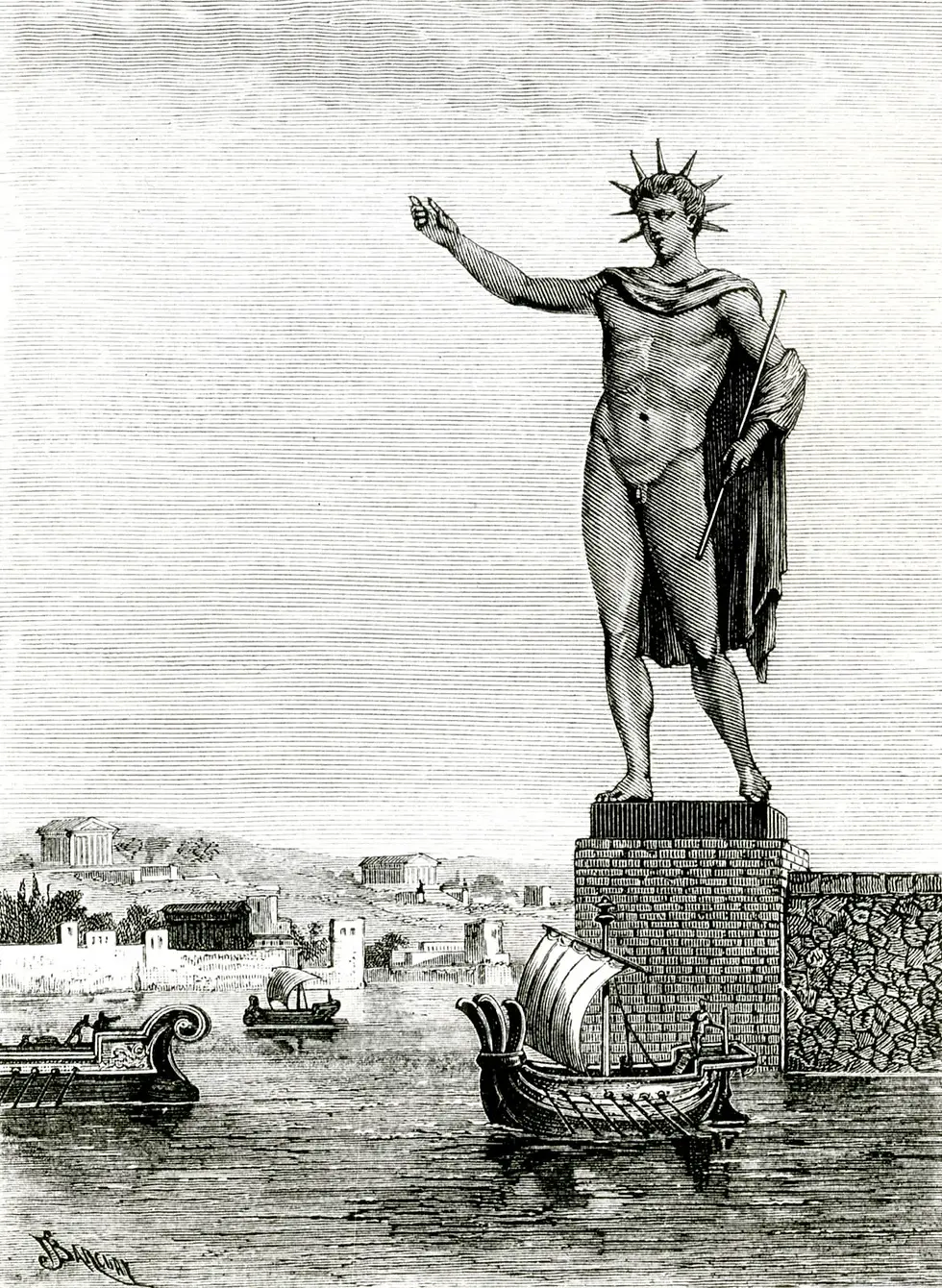
The Colossus of Rhodes was built using advanced techniques and technology of its time. It was one of the tallest man-made statues in the ancient world. Though it is often debated whether the statue is to the side or in the middle, where sailors had to sail beneath his open legs, the statue is still very remarkable. The statue depicts a naked man holding a torch and an arrow in his other hand while wearing a crown of spikes. It was believed to be built by mounting bronze plates onto a preexisting iron frame and adding stones inside for extra support and stability. As this was built in ancient times, there was no modern equipment to help with this ginormous project. The builders most likely used scaffolding and ramps to construct it. Despite all of these challenges, the builders worked very hard to meticulously create a statue that amazed many people from the ancient world.
Why might this be an ancient wonder of the world? This is because of the statue’s immense size, skillful construction and the powerful meaning it conveys. Standing at the entrance of the busy harbour, it was a constant reminder of the victory the people of Rhodes had, and also a symbol of freedom and resilience. It was a remarkable statue that attracted many individuals and the fact that it wasn’t built with modern technology is even more fascinating. Although, sadly, the statue was destroyed by an earthquake a mere 54 years later, the stories of it couldn’t stop spreading around the world. Today, the Colossus of Rhodes, is not only a reminder of human creativity and building techniques, but also a showcase of human determination when we work together.
In retrospect, the Colossus of Rhodes was clearly an inspiration to today’s society in what we can achieve. Built to honour the sun god Helios to celebrate their triumph in war, it became a symbol of victory, resilience and, of course strength, to the people of Rhodes. It stood tall, being the guardian of Rhodes and overlooking its trade, until its tragic end 54 years later. Even though it no longer stands, the Colossus of Rhodes continues to inspire awe and curiosity. This is because it left an impactful message of what humanity can do beyond just metal and bronze.

The Editors of Encyclopedia Britannica. “Colossus of Rhodes | Description, Location, & Facts | Britannica.” Encyclopædia Britannica, 2020, www.britannica.com/topic/Colossus-of-Rhodes.
Cartwright, Mark. “Colossus of Rhodes.” World History Encyclopedia, 25 July 2018, www.worldhistory.org/Colossus_of_Rhodes/.
Historian, The. “10 Facts about the Colossus of Rhodes.” Have Fun with History, 11 July 2023, www.havefunwithhistory.com/facts-about-the-colossusof-rhodes/.

